Showing posts with label discovery. Show all posts

Tuesday, January 20, 2015

Math Discovery Makes a Comeback!

After some successful science discovery time last week, I was encouraged and motivated to reintroduce math discovery in my classroom.  Discovery learning was an effective approach for me last year and I developed/sourced a number of discovery tub ideas (which I've pinned here).  Many of last year's discovery tubs focused on math learning and I knew that discovery time was valuable for developing students' numeracy skills. So, when students asked me about "putting numbers on the learning carpet", I decided it was time to get back to math discovery in our classroom. 

 I've included our most recent math discovery tubs and a list of contents for each below:

Discovery Tub Contents:
Various dice - I included 6 sided, 9 sided and 20 sided dice to meet the needs of a variety of learners.
Dominoes
White Board Markers
Laminated Roll the Dice and Domino Addition cards - These are basically "fill in the blank" addition and subtraction number sentence templates.  I already had them made and laminated from math games, so I used them but you could easily substitute any sort of blank number sentence templates.
 

Discovery Tub Contents:
Number cards for 0-100
Squares and triangles in different colours
Learning Carpet or other 100 grid

It was awesome to watch the students at this discovery tub work as a team to correctly "fill in" the hundred chart and develop colour patterns for odd and even.  They also had to decide on whether to create a zero-based 100 chart or to start at 1!  Some students asked each other to name the hidden number under a coloured card.


Discovery Tub Contents:
Playing card mats (printed from First Grade School Box blog)
Decks of cards (I included some with numerals only/no "dots" to count)

This was a returning tub from last year and it was neat to see students tackle more challenging number sentences and fact families! 

Discovery Tub Contents: Playing card mats (printed from First Grade School Box blog), Decks of cards (I included some with numerals only/no "dots" to count)  Students at this tub can: find cards to make the number sentence true, work with "fact families"/related facts/turnaround facts

Wednesday, January 14, 2015

Science Discovery Debuts in Grade 2

As part of our science learning on properties of solids, liquids and gases, we are learning about floating and sinking.  Since, Our discovery tubs were a huge hit in grade one last year, I decided to introduce some new ideas with discovery sessions this week.  Students found this type of learning very engaging and enjoyable and I am impressed with the learning, observing and questioning taking place. I felt that it was appropriate at the Grade 2 level to have students record some of their thinking, so as good scientists, each of my students is keeping a recording sheet of observations, materials, questions and ideas.  I put together two "types" of tubs: object tubs and construction tubs.  Each station had an additional water tub and a towel!  Read below to find out what our discovery tubs included this week!

Discovery Tub Contents:
Construction Tubs - these tubs encouraged learners to construct/build something from smaller parts

Tub 1
masking tape
popsicle sticks
plastic bottles (from recycling)
wooden rulers
clay

Tub 2
wooden blocks
plastic blocks
masking tape

Tub 3
aluminum pop cans (from recycling)
egg cartons (also recycled)
paper and cardboard (recycled)
masking tape


Discovery Tub Contents:
Object Tubs - these tubs encouraged learners to find out which individual objects would float or sink.  I used a variety of objects from around our classroom to fill each tub. 

Tub 1:
plastic cutlery
foam dice
plastic dice
plastic pieces
foam pattern blocks
wood pattern blocks
wooden blocks
plastic people manipulatives
coins
markers
foam dominoes
sponges

Tub 2:
egg cartons
plastic blocks
plastic fish manipulatives
dinosaur manipulatives
lego blocks
plastic mouse manipulatives
erasers
paper clips
popsicle sticks


Finding out which objects float and which objects sink

Putting materials together to build an object that will (hopefully) float!

Tuesday, May 27, 2014

Discovery Tubs Weeks 4 & 5

Time seems to be speeding up as the closing weeks of our school year fly by.  We've been working hard to continue learning and developing our skills in Grade 1.  Discovery learning continues to be an important part of our learning.  Here are our discovery tubs from the last couple of weeks:

Discovery Tub Contents:
Playing card mats (printed from First Grade School Box blog)
Decks of cards (I included some with numerals only/no "dots" to count)

Students at this tub can: find cards to make the number sentence true, work with "fact families"/related facts/turnaround facts 

Questions to ask: What card could go here?  Can you use different cards to make that number sentence true?  Is there another fact you can make with the same cards?  What other facts would be in this fact family? 


Discovery Tub Contents:
Domino addition mats (printed from First Grade School Box blog)
Dominoes

Students at this tub can:  practice addition using the dominoes, record number sentences to match the representation on dominoes, create their own addition sentences and draw new domino combinations to match 

Questions to ask:  How did you know that ____ + ____ was _____? , What would your domino look like to match your fact? 


Discovery Tub Contents:
Geoboards
Elastics
Label cards for a variety of shapes (rhombus, triangle, square etc)

Students at this tub can: replicate a variety of shapes, combine shapes to create a design, "freestyle" design, identify shapes within their design

Questions to ask: What shape did you create?  What shapes are in your design?  How many squares do you see in your design?  How many rectangles can you make on one board?  

Discovery Tub Contents:
Pattern blocks
Shape blocks
Pattern Block/Shape Block puzzles (such as these
Paper

Students at this tub can: solve puzzles provided, create a design and trace around their blocks to create a new puzzle, identify shapes

Questions to ask:  What block would fit there?  Could you use a different block in that spot?  What shape is that?  Can you create a puzzle? 


Discovery Tub Contents:
egg cartons cut into tens
blocks
paper

Students at this tub can: practice addition and subtraction with blocks, create addition and subtraction sentences to represent their work, count by 10s, work with multiple addends, count by 2s, practice grouping 

Questions to ask: How many blocks do you have altogether?  How can you count your blocks?  What do your egg cartons show?  How do you know?  How many numbers can you add together?  Can you show me subtraction?  


Discovery Tub Contents:
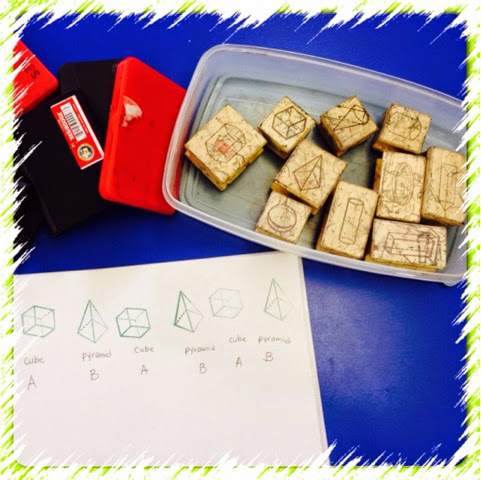
3D objects stamps
paper
ink
label cards for 3D objects (pyramid, sphere, prism etc)

Students at this tub can: create a pattern, identify and label 3D objects, extend a pattern, translate a pattern, discover the names for new objects by examining faces (ie: hexagon faces on a prism = hexagonal prism)

Questions to ask:  What is your pattern?  Can you translate your pattern?  What is the name of that objects?  Can you extend your pattern?  What would come next in your pattern? 


Wednesday, May 7, 2014

Discovery learning: Take 2

Last week in Grade 1, we tried out something new.  Discovery tubs were a big hit and both students and teachers learned a lot!  This week, Miss Dyck and I made a few changes.  For one, we decided to set up four tubs instead of three to make more "spaces" available and avoid "traffic jams" when there were students ready to change tubs and no spots available at the other tubs.

This week's tubs are shown below and also pinned on My Discovery Tubs board.

Discovery Tub Contents:
Book collection related to the seasons
Seasons cards showing seasonal pictures
Spring, Summer, Fall and Winter labels
Construction paper cut into cards
Magazines for cutting

Students at this tub could: sort the pre-made card by seasons, play seasons concentration game, cut and paste to create new cards.    

Questions to ask:  Why did you sort this card here?  How do you know that picture belongs in ____________?  What season does your card show? 


Discovery Tub Contents:
Toothpicks
Mini marshmallows
Sample 3D object created from toothpicks and marshmallows
Optional: label cards depicting 3D objects and 2D shapes

Students at this tub might: create 2D shapes or 3D objects, create a unique design or model (ie: one of my students designed a model of a catapult)

Questions to ask:  What shape/object have you created?  What shape are its faces?   How many vertices does it have?  How many faces does it have?


Discovery Tub Contents:
tangram sets
tangram puzzles 
paper for tracing new designs

Students at this tub might: solve pre-printed puzzles or design new puzzles by tracing around their own arrangement of tangrams

Questions to ask:  Where does this piece go?  Is that in the right place?  Does this piece go here?


Discovery Tub Contents:
Copies of nets for 3D objects such as cube, prism and pyramid
Model of a 3D object created from the net

Students at this tube may cut out nets and create a 3D object, create multiple objects and put them together (ie: a pyramid stacked on a cube) or cut out 2D shapes they recognize in the nets.  

Questions to ask:  What object/shape did you create?  How can you put it together to make a ___________?  Where should you fold the paper?  What will it look like when you are done?

Thursday, May 1, 2014

A New Approach: Discovery Learning

Inspired by two wonderful teachers, Connie Lowe and Devon Caldwell, I set out to introduce discovery learning in our Grade 1 classroom this spring!  I had a great conversation with these two ladies the evening before the Awakening Possibilities conference.  (Our conversation helped me "get going" on this idea and it was a reminder that sometimes the professional development happens outside of the official conference sessions - just talking with other teachers gave me some very useful ideas.)  

Next, I did some reading and exploring online to find out more about discovery learning, ideas for discovery tubs and how to organize these activities.  Some resources I found helpful included:
Miss Dyck, our student teacher, and I designed 3 discovery tubs related to our math learning about 2D shapes and 3D objects.  Once the tubs were set out at 3 separate work areas, I explained to students that there could be 5-7 people at a tub, they could choose which tubs to explore and when to change activities.  We discussed sharing, being kind and focusing on discovering new things.  Then, we got started!  Miss Dyck and I observed as students tried new things, worked together and created.  We took lots of photos and I put many of them into students' Evernote files to document their learning.  I took note of a few comments:
  • "I'm making something."
  • "Hey, watch this!"
  •  "Try this"
  • "Do ladybugs have antennae?" then, after an internet search and a close look at a ladybug diagram "So should I curve them (the antennae) a bit?"
  • "Give me the cylinder."
I heard lots of math language and many interesting questions.  I saw enthusiastic, engaged students working together or alone, creating new things and designing, learning and discovering!  After we cleaned up, students gathered at the carpet to share questions and comments. I asked for some feedback and it was overwhelmingly positive "It was fun" and "It was awesome" and even, "It was the best thing I've done at school".  Judging by our first experience, I think we're going to have to continue with our discovery learning! 

Discovery Tub Contents: 
2D shapes 
3D objects 
household objects that are cylinders, prisms, cubes, spheres etc 
2D shape & 3D objects label cards ie: cylinder, prism, square, circle, rhombus, hexagon 
Blank cards 

Students at this tub experimented with different 3D objects to create towers and they also sorted 2D shapes using the label cards.  

Discovery Tub Contents: 
2D shapes
shape "tracer" templates made from cardstock,
variety of paper 

Students at this tub created different designs by tracing shapes or cardstock tracers and they put shapes together to create pictures.  It was the most open-ended tub and it was interesting to watch what the students discovered when there were so many possibilities for them to explore!


Discovery Tub Contents: 
sample "shape bugs"
shapes copied onto construction paper (circle, oval, rhombus, rectangle)
blank construction paper

Students at this tub replicated the shape bug in the tub using preprinted shapes and/or shapes they cut out, created a ladybug shape bug and/or created other new designs using various shapes.
 

These tubs, along with those I will create in the future, are pinned here.