
This is an education-related blog written by Mrs. Leah Obach @LeahO77. Leah is currently working as the Literacy with ICT Teacher Leader for Park West School Division, working with K-12 students and teachers to help them use technology for teaching and learning. She has taught at the early years, middle years and high school levels. Student work, teacher reflection, resources and samples from classrooms around PWSD are included in this blog.
Friday, October 7, 2016
Our first book: Is this a ball?


Saturday, September 24, 2016
Hack the Classroom: September 2016
I was very fortunate to be invited to present at Microsoft's first Hack the Classroom event in January 2016. It was an inspiring event that involved thousands of educators from around the globe, so I was really excited to register as an online attendee for this fall's event! With a line-up of passionate presenters sharing today, Hack the Classroom again inspired me. I'm excited to see what another year will bring in our connected classroom!
John Kao of Edgemakers shared about his passion for innovation in education. According to their website, "EdgeMakers offers an interdisciplinary practice-based and purpose driven, challenge- and project-based learning system currently delivered to students in grades 5-8, high school, and institutions of higher learning in The United States, Brazil, Colombia and India. It consists of five core courses..."
What is innovation?
Kao asserts that innovation is "developing capabilities to achieve a desired future" which means we need to narrow the gap between what students are learning in school and what they will need to be successful in their futures.
What if the world's young people learned how to be innovators and entrepreneurs?
At Edgemakers, they ""assert that the idealism and passion of the young are one of the most underutilized resources on the planet."
I strongly agree with Kao's belief that young people can make a contribution to the world and solving our problems. As an educator, I think an important role of education is to foster the development of citizenship skills. I make an effort in my own classroom to let students tackle real world problems that they have identified as important and encourage them to take on projects that help others. Some such projects have included teaching others to code, purchasing school supplies for a partner school in Africa, volunteering at an animal rescue, promoting sustainability with reusable bag use and reducing our classroom trash.
Lauren Pittman is using the OneNote learning tools to help her students with special needs become more successful readers. I am definitely going to be investigating these tools further after watching this powerful video featuring her classroom!
Dyane Smokoroski is a Microsoft Expert Educator and Skype Master Teacher. She believes that teachers are in the business of inspiring students. She uses Skype to play Mystery Skype, connect with experts and take her students on virtual field trips. She even took us on a brief Skype virtual field trip to the North Carolina Museum of Natural Sciences!
Dyane also allows students from all over the world to showcase their creativity through her Awesome Squiggles collaborative art project. Registration is closed for this year, but I'm looking forward to "unofficially" trying the project with students and sharing it through social media!
Patricia Romero is using Minecraft to engage her learners at the American Institute of Monterrey . She shared her tips for using Minecraft in the classroom:
The 2016 Skype-a-thon is coming up on November 29th and 30th. Sign up to connect your classroom!
Check out the Hack the Classroom Sway and sign up to watch the recorded webinar on the Hack the Classroom event website.
John Kao of Edgemakers shared about his passion for innovation in education. According to their website, "EdgeMakers offers an interdisciplinary practice-based and purpose driven, challenge- and project-based learning system currently delivered to students in grades 5-8, high school, and institutions of higher learning in The United States, Brazil, Colombia and India. It consists of five core courses..."
What is innovation?
Kao asserts that innovation is "developing capabilities to achieve a desired future" which means we need to narrow the gap between what students are learning in school and what they will need to be successful in their futures.
What if the world's young people learned how to be innovators and entrepreneurs?
At Edgemakers, they ""assert that the idealism and passion of the young are one of the most underutilized resources on the planet."
I strongly agree with Kao's belief that young people can make a contribution to the world and solving our problems. As an educator, I think an important role of education is to foster the development of citizenship skills. I make an effort in my own classroom to let students tackle real world problems that they have identified as important and encourage them to take on projects that help others. Some such projects have included teaching others to code, purchasing school supplies for a partner school in Africa, volunteering at an animal rescue, promoting sustainability with reusable bag use and reducing our classroom trash.
Lauren Pittman is using the OneNote learning tools to help her students with special needs become more successful readers. I am definitely going to be investigating these tools further after watching this powerful video featuring her classroom!
Dyane Smokoroski is a Microsoft Expert Educator and Skype Master Teacher. She believes that teachers are in the business of inspiring students. She uses Skype to play Mystery Skype, connect with experts and take her students on virtual field trips. She even took us on a brief Skype virtual field trip to the North Carolina Museum of Natural Sciences!
Dyane also allows students from all over the world to showcase their creativity through her Awesome Squiggles collaborative art project. Registration is closed for this year, but I'm looking forward to "unofficially" trying the project with students and sharing it through social media!
Patricia Romero is using Minecraft to engage her learners at the American Institute of Monterrey . She shared her tips for using Minecraft in the classroom:
- don't be afraid
- start small
- get organized
- plan ahead
- empower students
- set rules
- build a team
- share work
- grow your program
The 2016 Skype-a-thon is coming up on November 29th and 30th. Sign up to connect your classroom!
Check out the Hack the Classroom Sway and sign up to watch the recorded webinar on the Hack the Classroom event website.
Thursday, September 22, 2016
Our Pattern Pictures
Our current grade 1 math learning is focused on patterns. The patterning goals for grade 1 students are:
- describe a pattern
- extend a pattern that is already started
- create a pattern
- translate a pattern (ie: green, yellow, green, yellow, green, yellow could be translated to ABABAB)
Wednesday, June 22, 2016
2016 Maker Faire & Yoga Festival
Our partner class, Mrs. Caldwell's Kindergarten class in Miniota, hosted a Maker Faire and Yoga Festival yesterday! Over the last several weeks, we have had video calls with them to help plan this exciting event. While their class took the lead role in planning and organizing this special day, our class also took responsibility for some jobs and we were excited to travel to their school to participate.

Maker Faire
I first took an interest in the maker movement after hearing about it at Hack the Classroom. Making wasn't new to our grade 1 class - we make art, write books, bake muffins, build with cardboard, create with code, play with lego and more. However, after I learned more about the maker movement, we did try some new "maker stations" this spring and students really enjoyed the extra opportunities to be creative. When we discussed our maker activities with the MES Kindergartens, the idea of a Maker Faire seemed like a great way to end the year!

Yoga Festival
Since yesterday (June 21st) was International Day of Yoga, we also celebrated with yoga activities while we were in Miniota. Yoga is a great way for us to exercise, plus it teaches us to focus and calm ourselves which helps us be better learners! For the yoga festival, students rotated through five different yoga stations including partner poses, individual pick-a-pose, musical mats, breathing practice and mindfulness practice. Then, a huge group of students and adults gathered in the gym to participate in a yoga class led by Mrs. Caldwell, who is a trained yoga teacher!

It was a wonderful day and we are so glad that we've had a great year of partnering with the Miniota Kindergartens!

Maker Faire
I first took an interest in the maker movement after hearing about it at Hack the Classroom. Making wasn't new to our grade 1 class - we make art, write books, bake muffins, build with cardboard, create with code, play with lego and more. However, after I learned more about the maker movement, we did try some new "maker stations" this spring and students really enjoyed the extra opportunities to be creative. When we discussed our maker activities with the MES Kindergartens, the idea of a Maker Faire seemed like a great way to end the year!
What is a
Maker Faire?
The Kindergartens included the following description when designing the event invitations "A Maker
Faire is when a whole bunch of people come together to make, create, invent,
and solve problems. We use things like cardboard boxes, tape, string, staplers,
wool, craft sup-plies, recycled items, and technology. Making is good for kids
and grown ups because it helps us be creative, work with others, and solve problems" There is more information on the official Maker Faire website.
Since yesterday (June 21st) was International Day of Yoga, we also celebrated with yoga activities while we were in Miniota. Yoga is a great way for us to exercise, plus it teaches us to focus and calm ourselves which helps us be better learners! For the yoga festival, students rotated through five different yoga stations including partner poses, individual pick-a-pose, musical mats, breathing practice and mindfulness practice. Then, a huge group of students and adults gathered in the gym to participate in a yoga class led by Mrs. Caldwell, who is a trained yoga teacher!
What is
International Day of Yoga?
Mrs. Caldwell and the Kindergartens included the following description when designing the event invitations "The United Nations declared June 21st as International
Day of Yoga. We practice yoga to help our bodies get strong and flexible and to
feel calm and happy. Yoga helps us focus, and this makes it easier to learn at
school. Anyone can do yoga!"

It was a wonderful day and we are so glad that we've had a great year of partnering with the Miniota Kindergartens!
Tuesday, June 21, 2016
Minecraft Animal Homes
This year, a group of Canadian Microsoft Expert Educators have been working on using Minecraft for learning. I was inspired by the other educators ideas for using Minecraft in the classroom, so I decided to give it a try with my grade 1 students. One of our science outcomes is that students will be able to design a representation of a habitat/home that meets the needs of a Manitoba animal, so our Minecraft design challenge focused on that. We learned about the characteristics and needs of living things as we worked on this project. Below I have outlined the steps we took in this project.
Brainstorming: Our whole class worked together to brainstorm a list of Manitoba animals.
Setting criteria: We worked together to set criteria for what our animal home designs should include.
Research: Once we set criteria for the task, I put students into small group and they selected an animal from our list to research. Groups of three students researched what that animal would need for food and shelter and completed the provided template.

Designing: Next, students used what they learned in their research to design a representation of an animal home for their animal. As students did this, I was able to walk around the room and have discussions with students about why they were making certain design choices and how their habitats would meet animal needs. From those conversations, I could tell that my students had already learned a lot.


Sharing: We tried to present our Minecraft worlds on our interactive whiteboard, but that presentation style didn't work well, so we came up with a new plan to share our work. Each group took a few screenshots to highlight how their habitat design met the basic needs of their animal. They added short captions to each screenshot and then created short videos which were shared with the whole class.
Brainstorming: Our whole class worked together to brainstorm a list of Manitoba animals.
Setting criteria: We worked together to set criteria for what our animal home designs should include.
Research: Once we set criteria for the task, I put students into small group and they selected an animal from our list to research. Groups of three students researched what that animal would need for food and shelter and completed the provided template.
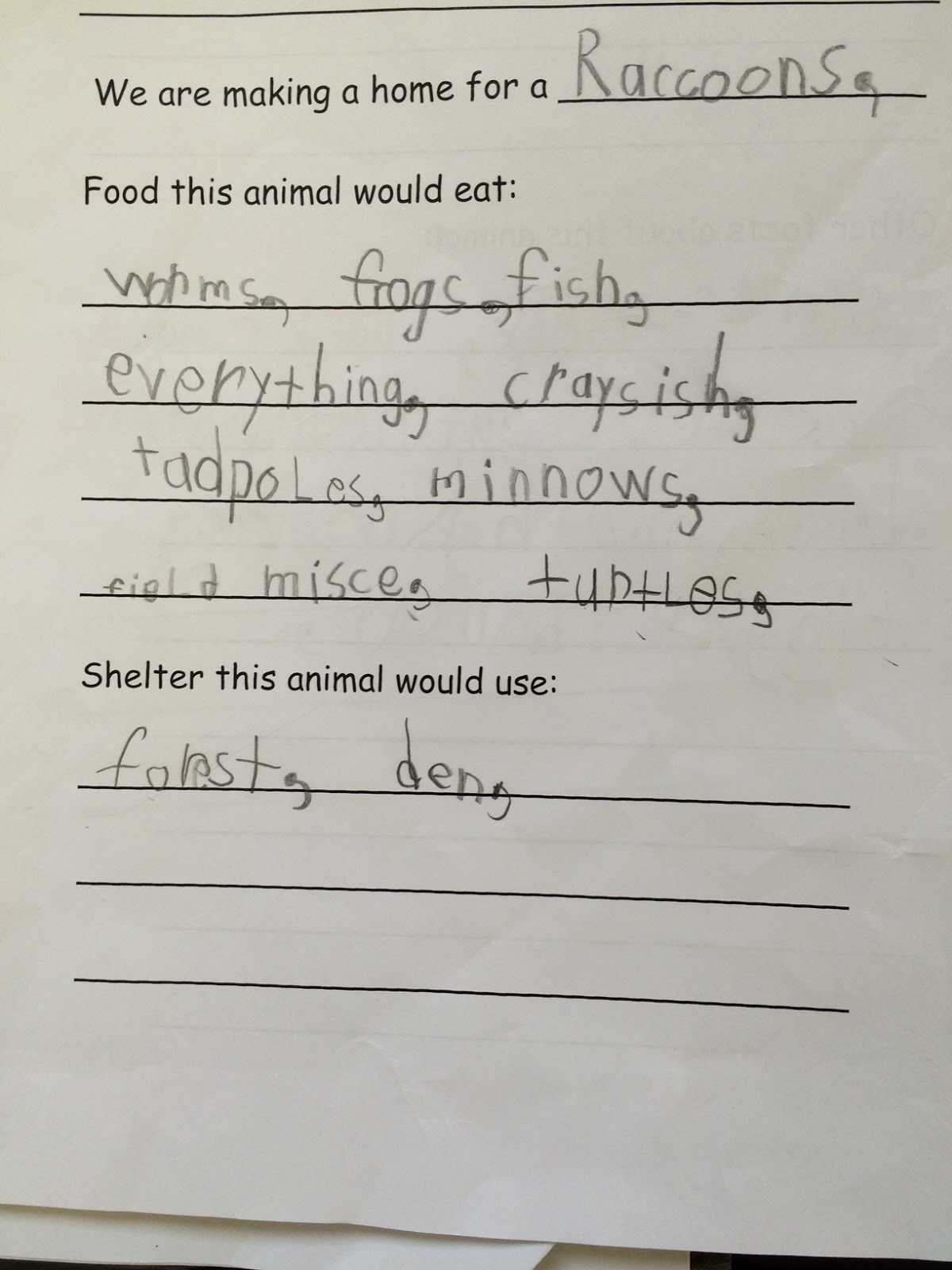
Designing: Next, students used what they learned in their research to design a representation of an animal home for their animal. As students did this, I was able to walk around the room and have discussions with students about why they were making certain design choices and how their habitats would meet animal needs. From those conversations, I could tell that my students had already learned a lot.


Sharing: We tried to present our Minecraft worlds on our interactive whiteboard, but that presentation style didn't work well, so we came up with a new plan to share our work. Each group took a few screenshots to highlight how their habitat design met the basic needs of their animal. They added short captions to each screenshot and then created short videos which were shared with the whole class.
Monday, June 13, 2016
Thursday, June 9, 2016
The Frog Princess
We have been studying fairy tales. We have read many different fairy tales and fractured tales. This is a fairy tale that our class wrote together. You can flip through the pages here.
Subscribe to:
Posts (Atom)