Showing posts with label math. Show all posts

Tuesday, March 16, 2021

Scavenger Hunts with Seesaw

 More and more teachers in our school division are using Seesaw with students.  Seesaw is a great tool to use for collecting student work samples in a digital portfolio (or learning journal, as Seesaw calls it).  Teachers can also create or source activities for students to complete in Seesaw, which was super helpful during remote learning and continues to be useful for classroom learning activities.  

I've found some good Seesaw scavenger hunt activities created by other teachers and now created some of my own templates to share with colleagues as well.  The concept of a scavenger hunt works well for any grade level and subject area because you can customize your list of scavenger hunt items to whatever skills or knowledge your students are working on.  

I like that these Scavenger Hunt activities allow students to apply their skills and knowledge by finding examples of the concepts they've been working with.  I also like that there are many ways for students to show their examples: they could take a picture, write with the pens, type their response or even take a video.  

Examples of Seesaw Scavenger Hunts:

click the links to find these activities and creators on Seesaw


Seesaw Templates for Creating a Scavenger Hunt


I like to keep a template that I can copy and edit in Seesaw to make new scavenger hunts for different grade levels or subjects. I've created a single page or multipage template, both of which you can access below! You can customize an activity by following the steps here.  


I'm pleased to be part of the Seesaw Ambssador program and I'm happy to share about this tool with my teacher friends and colleagues!  Find me on social if you have questions or would like to connect.

Connect with Leah online:

Twitter: @LeahO77 

Instagram: @kgeducation.ca @mrsobach

Facebook: @kgeducation.ca


Thursday, September 22, 2016

Our Pattern Pictures

Our current grade 1 math learning is focused on patterns.  The patterning goals for grade 1 students are:
  • describe a pattern
  • extend a pattern that is already started
  • create a pattern
  • translate a pattern (ie: green, yellow, green, yellow, green, yellow could be translated to ABABAB)
An important part of learning in our classroom is connecting with others.  Over the course of our school year, our class will connect with other classrooms, experts, authors and others that can help us learn.  This week, we connected with a partner classroom, the Oak Lake Community School Kindergarten class, via video call.  The grade 1s were able to explain what they know about patterns and they helped teach the Kindergartens about patterns.  I was pleased to hear my grade 1s explaining that "patterns repeat over and over" and the grade ones capably started patterns for the Kindergartens to extend.  Our challenge after the call was to go on a "pattern hunt" to find and photograph patterns.  Below is the Sway presentation we created with the photographs from both classes.  We also included photos from our earlier work in creating patterns.  Students were excited to share this presentation with their families during the school open house!

Monday, February 29, 2016

Capacity Investigation

It is a leap year, so we have an extra 24 hours!  We spent our 24 hours learning and being creative! We measured how much different cups to hold and created a video in MovieMaker.  We shared our video on Twitter for the #my24hrs project!


Wednesday, September 23, 2015

Time for Patterns

Mrs. Obach's smart Grade 1 learned about patterns in math.  We can make patterns, translate patterns and find patterns. We can teach you about patterns in this video.  Our class can take pictures of patterns.  This is our first time making a video to show what we learned and this is also our first class blog post!  We hope you like our video!


Tuesday, January 20, 2015

Math Discovery Makes a Comeback!

After some successful science discovery time last week, I was encouraged and motivated to reintroduce math discovery in my classroom.  Discovery learning was an effective approach for me last year and I developed/sourced a number of discovery tub ideas (which I've pinned here).  Many of last year's discovery tubs focused on math learning and I knew that discovery time was valuable for developing students' numeracy skills. So, when students asked me about "putting numbers on the learning carpet", I decided it was time to get back to math discovery in our classroom. 

 I've included our most recent math discovery tubs and a list of contents for each below:

Discovery Tub Contents:
Various dice - I included 6 sided, 9 sided and 20 sided dice to meet the needs of a variety of learners.
Dominoes
White Board Markers
Laminated Roll the Dice and Domino Addition cards - These are basically "fill in the blank" addition and subtraction number sentence templates.  I already had them made and laminated from math games, so I used them but you could easily substitute any sort of blank number sentence templates.
 

Discovery Tub Contents:
Number cards for 0-100
Squares and triangles in different colours
Learning Carpet or other 100 grid

It was awesome to watch the students at this discovery tub work as a team to correctly "fill in" the hundred chart and develop colour patterns for odd and even.  They also had to decide on whether to create a zero-based 100 chart or to start at 1!  Some students asked each other to name the hidden number under a coloured card.


Discovery Tub Contents:
Playing card mats (printed from First Grade School Box blog)
Decks of cards (I included some with numerals only/no "dots" to count)

This was a returning tub from last year and it was neat to see students tackle more challenging number sentences and fact families! 

Discovery Tub Contents: Playing card mats (printed from First Grade School Box blog), Decks of cards (I included some with numerals only/no "dots" to count)  Students at this tub can: find cards to make the number sentence true, work with "fact families"/related facts/turnaround facts

Wednesday, June 18, 2014

Baseball Math Problem Solving

We wrote this problem for others to solve.  Please send us your answer or comment with your answer.  You can Tweet @MrsObachsClass or email lobach@pwsd.ca

Wednesday, June 11, 2014

Baseball Math Problems

We solved a baseball problem in math today.  If you are reading this blog post, we would like you to send us a baseball math problem (but not too hard!) please.  You can Tweet us @MrsObachsClass or email us.  


Tuesday, May 27, 2014

Discovery Tubs Weeks 4 & 5

Time seems to be speeding up as the closing weeks of our school year fly by.  We've been working hard to continue learning and developing our skills in Grade 1.  Discovery learning continues to be an important part of our learning.  Here are our discovery tubs from the last couple of weeks:

Discovery Tub Contents:
Playing card mats (printed from First Grade School Box blog)
Decks of cards (I included some with numerals only/no "dots" to count)

Students at this tub can: find cards to make the number sentence true, work with "fact families"/related facts/turnaround facts 

Questions to ask: What card could go here?  Can you use different cards to make that number sentence true?  Is there another fact you can make with the same cards?  What other facts would be in this fact family? 


Discovery Tub Contents:
Domino addition mats (printed from First Grade School Box blog)
Dominoes

Students at this tub can:  practice addition using the dominoes, record number sentences to match the representation on dominoes, create their own addition sentences and draw new domino combinations to match 

Questions to ask:  How did you know that ____ + ____ was _____? , What would your domino look like to match your fact? 


Discovery Tub Contents:
Geoboards
Elastics
Label cards for a variety of shapes (rhombus, triangle, square etc)

Students at this tub can: replicate a variety of shapes, combine shapes to create a design, "freestyle" design, identify shapes within their design

Questions to ask: What shape did you create?  What shapes are in your design?  How many squares do you see in your design?  How many rectangles can you make on one board?  

Discovery Tub Contents:
Pattern blocks
Shape blocks
Pattern Block/Shape Block puzzles (such as these) 
Paper

Students at this tub can: solve puzzles provided, create a design and trace around their blocks to create a new puzzle, identify shapes

Questions to ask:  What block would fit there?  Could you use a different block in that spot?  What shape is that?  Can you create a puzzle? 


Discovery Tub Contents:
egg cartons cut into tens
blocks
paper

Students at this tub can: practice addition and subtraction with blocks, create addition and subtraction sentences to represent their work, count by 10s, work with multiple addends, count by 2s, practice grouping 

Questions to ask: How many blocks do you have altogether?  How can you count your blocks?  What do your egg cartons show?  How do you know?  How many numbers can you add together?  Can you show me subtraction?  


Discovery Tub Contents:
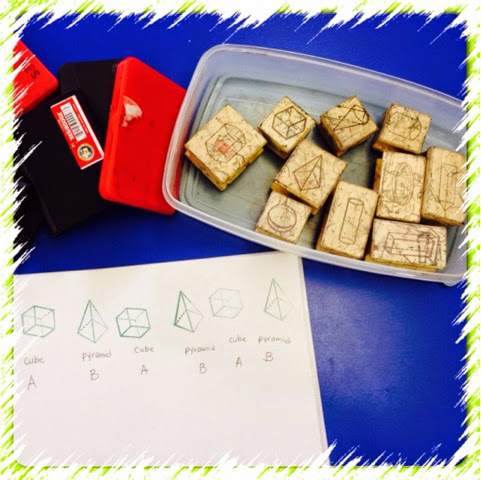
3D objects stamps
paper
ink
label cards for 3D objects (pyramid, sphere, prism etc)

Students at this tub can: create a pattern, identify and label 3D objects, extend a pattern, translate a pattern, discover the names for new objects by examining faces (ie: hexagon faces on a prism = hexagonal prism)

Questions to ask:  What is your pattern?  Can you translate your pattern?  What is the name of that objects?  Can you extend your pattern?  What would come next in your pattern? 


Tuesday, May 20, 2014

Mystery Number Skype

We have used Skype in our classroom throughout the year, but recently we've been doing something new and exciting called Mystery Number Skype. After attending Kathy Cassidy's presentation at Awakening Possibilities last month, Mrs. Caldwell and I were excited to try out this new learning activity with our students.  We also tried this activity with Miss Turner's K/1 class in Treherne today!

How We Do Mystery Number Skype:
  •  Each class chooses a mystery number.  Teachers and students can decide on a range such as 1-100.  
  • Classes connect via video call. One class goes first, and asks the other class yes/no questions to narrow down what the mystery number could be. 
    • Some great questions are being asked in our classes right now:
      • Is it higher than __?
      • Is it lower than __?
      • Is it between __ and __?
      • Is it in the thirties? forties? etc. 
      • Is it even/odd? 
      • Does it end with ....?
      • Does it start with...?
  • Once the first class guesses the number correctly, the other class takes their turn.
Helpful Tools
We have been using the interactive hundred chart in SMART Notebook to keep track of the numbers we eliminate. As it is narrowed down, students "erase" the numbers on the board.  If you don't have access to the interactive hundred chart, a copy of the 100 chart to cross off guesses could be shared by the class or used individually by each student. We also use our Front Row audio system microphone to pass around, which helps to amplify student voices so they are more easily heard during the conference call. 

A friendly competition...
To make Mystery Number Skype into a bit of a competition/game, our classes have competed to see who could solve the mystery number in the fewest number of questions . Students kept a tally of guesses and so far the OLCS Kindergartens have asked fewer questions than us, so we are working hard to ask really smart questions in hopes of winning next time!  It's a fun and motivating element that encourages us to eliminate the most numbers we can with each of our questions.

Important Learning
This Mystery Number Game has led to much learning.  We've discussed decade numbers and learned about even and odd.  Students have the opportunity to think about numbers and formulate good questions.  I'm very excited to see the math learning that is going on during these calls!

Keep in mind that any video calling tool will work for this activity or you can even play with a special guest or partner classroom in your own school!

Mrs. Caldwell has shared a great post about her perspective on Mystery Number Skype too - check it out!

Thursday, May 8, 2014

More on Daily 5 Math

Following our Microsoft Expert Educator webinar last night, Mrs. Caldwell and I checked out #mbedchat on Twitter for some additional PD.  These weekly Wednesday night chats are archived on the Manitoba Ed Chat website for interested educators.  I found that many other teachers were interested in the Daily 5 Math activities that we are doing in Grade 1 and I referred them to my post about starting Daily 5 math last year.  I also decided that I'd share more details in this post, in hopes of helping other teachers.

Daily 5 Math in our classroom includes five different independent activities that students can do to practice their math skills while I am teaching math to small groups of students.  My aim is to provide meaningful opportunities for students to apply their math skills, engage in math thinking and have fun while I am directly teaching other students. 

The Daily 5 Math choices in our classroom include:
  • Math with a Partner
  • Math by Myself / Math Problem Solving
  • Math Writing
  • Math with Technology
  • Math Practice
You can read about how we do Math with a Partner, Math Practice and Math with Technology in my original post. 

Math by Myself / Math Problem Solving:
This Daily 5 Math choice involves students working independently to solve math problems.  I create a variety of different math problems, varying in difficulty and color code them.  In our problem solving binder, each student has a 9-slot sheet filled with 9 different problems to work on. (The sheets are designed to hold trading cards and you can find them at the dollar store).   Students pick which problem to work on and glue it into their math journal.  We've already learned a variety of problem solving strategies, so students may draw a picture, use a number line, use an addition sentence, count on/count back or use manipulatives to solve the problem.  They record their work and their answer, then move on to another problem if time permits.  You can download some math story problems in my Excel template - feel free to use the problems or to create your own problems using the template.  


Math Writing:
This Daily 5 Math choice involves students writing about math.  Students can write addition or subtraction stories or model their writing after a math book. I ask that students writing math stories provide an answer for their work.  Often we will share our stories in our classroom or on our class Twitter account @MrsObachsClass and give other students the opportunity to find the answers. 

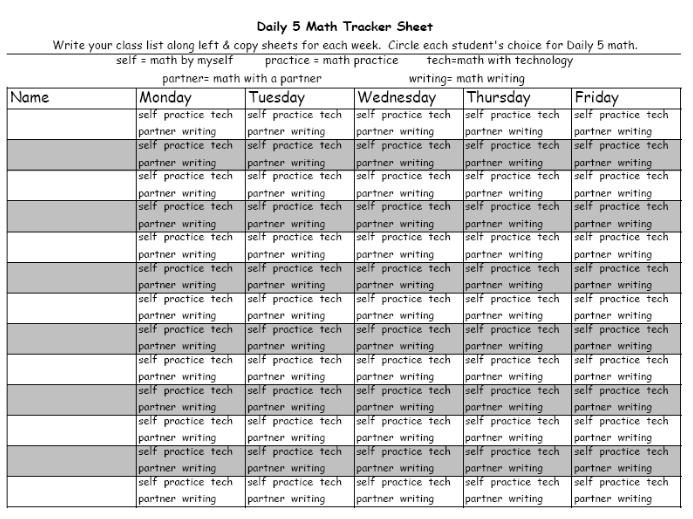
If you're a teacher thinking of starting Daily 5 math, my weekly tracker is available here for you to use.  

Monday, January 13, 2014

We're Back!

We all had really good Christmas holidays.  Now we're back to school and having fun!  Today, we did 11 for number of the day.  Here is our work:


Tuesday, October 8, 2013

Can you solve this problem?


We are learning about making 10.  Some ways we tried solving this problem were: counting on, counting the empty squares, filling the squares with counters, counting back. 

Monday, October 7, 2013

Number of the Day: 7

We write ways to make a number for math. We used patterns, ten frames, the number word, adding, subtraction and tallies.  Some of us thought of VERY tricky ways to make 7! 

Wednesday, October 2, 2013

Number of the Day

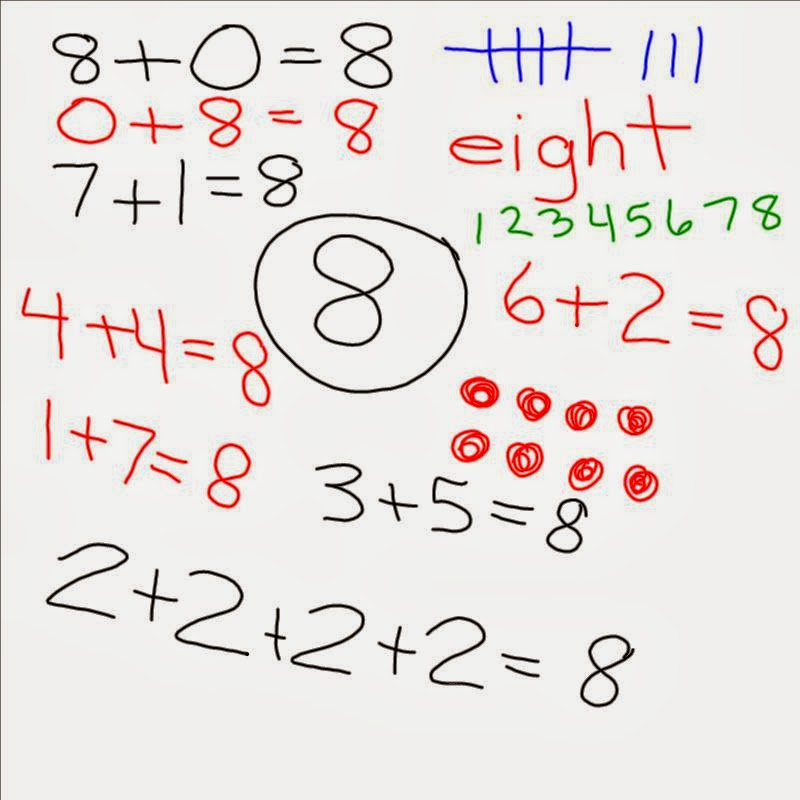
In Grade 1 Math, we are learning about numbers.  We are learning to show numbers in different ways.  Today, we did a number of the day activity.  We showed different ways to represent 8 in our math journals and we recorded ideas on our SMARTboard.  Here's what our ideas looked like:

Friday, September 27, 2013

Smart Kids Use Numbers

We made our first video yesterday.  It was about numbers and we shared it with our families at the open house last night.  Now we hope more people will watch it.


Thursday, September 26, 2013

Pattern Hunt Home Activity

We've been learning all about patterns in grade 1.  We're really good at recognizing patterns, extending patterns and translating patterns.  Our job with our families is to find patterns in our homes, yards and neighborhoods.  Feel free to join our pattern activity and share photos on your blog or on Twitter so we can see them!  Send your Tweets @mrsobachsclass or post a link in our comments.  Here are some we've found so far:


Addison's popcorn bowl

Camryn's pumpkins

 
 Jaxen's vase

 Kayleigh's bins

Madison - the roof of the drug store


Peyton's bales
 Landon's trampoline
Wyat's hydro poles
Connor's blanket


Tuesday, September 24, 2013

Why we need numbers

During math today, we starting talking about numbers.  We're going to be learning lots about numbers this year, so we started thinking of some reasons we use numbers.  Please add your ideas by sending us a Tweet @mrsobachsclass or leaving a comment on this post!


Monday, May 27, 2013

Math Strategies: Here's What We're Thinking...

Today we discussed some strategies we can use when adding or subtracting.  We used 8+9 as an example and recorded our strategies in thought bubbles to show what we might be thinking while we figured out that problem.  Next, we labeled each strategy with a name.


Wednesday, February 20, 2013

Daily 5 Math: Tracker Sheet

This week I designed my tracker sheet to help me monitor which Daily 5 activities students have completed throughout the week.  You can download the editable Excel file here or the ready to print PDF file here.