Showing posts with label student directed learning. Show all posts

Thursday, June 13, 2019

Sarah's Passion Project: The History of Dance

This is a guest blog post written by grade 6 student, Sarah.

Our grade 6/7 Character Ed class is working on projects, but these projects aren’t just normal projects, they’re Passion Projects! All of us are putting together a project that shows what we’ve accomplished over the days. We got to choose what our projects would be about! My passion project is about the history of dance and how it has become what it is today. Our passion projects are about what we love! This is my Passion Project:

History of Dance
By: Sarah Chappell

King Louis the 14th first invented ballet for a wedding in 1459. Dancers would dance about the dishes being served. Pierre Beauchamp, King Louis’ teacher, became the first dance director in Paris for the first ballet training school in 1671. In the 1700s, ballet became more popular and King Louis performed as a dancer. Pierre also invented the technical term “turnout” in ballet.
People from different cultures even incorporate dance into their cultures. Dancing is important for different cultures because it helps them embrace who they are and their cultures. Some cultures dance during celebrations.


Some of the most popular dances are…. Hip-Hop, which is street dancing performed with usually Hip-Hop music. Tap Dance, which is basically just tapping on a hard surface with technical form, of course! Belly Dance, which is when people move their bellies in different ways. Break Dancing or B- Boying, which is when people pop and lock and resist your motions, or just doing awesome tricks! Lastly, ballet, which is a VERY VERY technical art that is performed with such grace, passion and emotion!


In the 1830s a lady named, Marie Taglioni, made dancing on Pointe very popular. She danced a ballet for her father and after her last beautiful, moving performance, the people were so sad to see her go that one chef took her ballet shoe and cooked it! They say that all of her fans ate it too!


Also in the 1840s, a man performer named, Marius Petipa, made more than 60 ballets. His assistant, Lev Ivanov, choreographed some of the most popular ballets today! His work included, The Nutcracker, Swan Lake and Sleeping Beauty!!

There are many places around the world that dance in different ways to express their culture and religion. China has the dragon dance, Cuba has the Salsa, Russia has ballet, Switzerland has the traditional folk dance, Argentina has the tango, and Brazil has the Samba, just to name a few! Not all countries or cultures just have to stick to one type of dance, everyone can just dance to their own rhythm!

Dance today is all about freedom and imperfection, (unless you’re in a competition, but if you’re not then you can just dance freely!) You should just be able to do what you really love! Dance today has many more styles that suit everyone, and it has lots of movement and freedom!   

Dances in different cultures are more traditional and dances in my culture/country can be more technical and professional, but it can also be non-competitive and flowy!
Clearly, dance was very different a long time ago compared to dance now! But they do have some similarities, freedom, commitment, and passion!  What I’ve learned is that dance is a passion and it’s….. I can’t explain it but, it just makes you feel free and safe and it takes your mind off of everything else in the world! Dance is my passion!   

Sources:

Tuesday, June 4, 2019

Passion Projects: Haily's Hockey Project

This is a guest blog post written by Grade 6 student, Haily.

In our grade 6/7 class we are doing passion projects! That means you can pick anything that you are passionate about as long as you can show that you are learning something. Some of the passion projects are putting on bake sales, talent shows learning more about sports and history and making paper mache  and much more! Our class has really enjoyed learning about the things we love to do!


For my passion project I did a research project about hockey facts and players. I included things like the top point leaders of 2019, trivia, best hockey team and best hockey player ever and more. The file is set up so you can play the trivia if you download it.

- Haily Johns

Wednesday, January 31, 2018

Sharing Knowledge and Building Skills with Video Production

One way for students to demonstrate their understanding is through video production.  In my role as LwICT Teacher Leader, I was privileged to work with Mrs. Facey and her awesome group of Grade 8s on a video production project this term.   The grade 8 class was working on a "Power of Media" theme along with Project 11 activities on self-esteem.  Mrs. Facey gave her students the opportunity to produce videos as part of their learning.  Not only did the class create some powerful videos to share, they also engaged in deep, meaningful learning.

Although I was not in the classroom every day of this project, it was evident during my classroom visits that the grade 8s were learning a lot.   Their project included a wide variety of learning activities/assignments, such as:
  • research on self-esteem
  • viewing and analyzing existing media related to self-esteem
  • planning: students identified their target audience and intended message, they planned a style/format for their video and identified setting, actors etc.
  • script writing: students learned to use a two column script to plan for audio and visual aspects of their videos
  • revising and editing: students worked hard to make their work high quality, which involved revising based on peer feedback and teacher feedback
  • videography: students filmed, edited and shared their videos 

When students completed their scripts, they were grouped into video production teams.   The team then had to review each team member's script and decide which video(s) to produce.  When I met with a team at this stage of the project, I was so impressed with the collaboration, negotiation and discussion taking place.  Once a script was selected by the team, they undertook further revisions and planned their set, props and costumes.   Next, the groups assigned roles such as director, assistant director, videographer and editor.  They selected actors to fill each role.   Once their plans were in place, students used the school's available video equipment and filmed footage on an iPad.   Upon completing filming, editors worked in iMovie.  The final products were shared on the class YouTube channel in hopes of reaching their target audiences.  Students started sharing their work and made a plan to reach their targeted audiences.


The final videos are very well done and very powerful.   I would encourage you to watch them below.  However, the final videos can only begin to show the meaningful learning that these students engaged in throughout the project.   I'm sure that my short description above cannot fully convey all of the learning that took place, but from meeting with this class, I know that they gained valuable knowledge and developed important skills through this project. 

Why I Think This Project is Awesome
Yes, the videos are excellent and that definitely makes this project awesome, but behind those videos was a lot of learning that make this kind of project so worthwhile.  As a teacher, I saw a lot of good things happening with this project. 


Purpose for Learning: I've written before about students doing "work that matters" and I think this is an excellent example. Students created these videos because they wanted to share an important message and have an impact with their work.  Some groups focused on educating others about self-esteem while other groups shared messages to encourage and uplift others.  Regardless of the message, students were writing, revising, editing, filming and sharing for a purpose. They had a reason to read, write, view, analyze and discuss. 

Authentic Audience:  Students identified an audience that they wanted to reach and actually shared their videos in places where those people could access them.   I love when audiences outside of the classroom get to see the great work that students are doing!

Building Skills: The variety of learning activities involved in completing this project provided opportunities for students to develop skills in collaboration, communication, problem solving and critical thinking.


Thursday, March 9, 2017

Polar Bear Project: Is this a polar bear?

A massive blizzard hit southwestern Manitoba this week, closing our school for two days and leaving behind massive amounts of snow.  Today our school reopened, but the buses were not running so we had a smaller group of students than usual.  We were working on wrapping up a few jobs from our polar bear project when one student suggested we write a book "Is this a polar bear?" based on a model text Is this a moose? which we had studied earlier in the year.  I was happy to hear that my students wanted to write and were generating ideas for their writing, so we went with this idea as our writing project for today.  Each student chose an animal and selected the image for their page, then wrote their part.  Our final product looks great and the students were excited to do a shared reading of their new book this afternoon! They were eager to share the book online, so I've scanned a copy and made it available online using OneDrive. 

Check out our latest class book, Is This a Polar Bear? with images by pixabay.com  Click on the title page, then scroll to view additional pages. 


Thursday, April 7, 2016

Marvelous Muffins: Fundraising Success!

With the help of some great volunteers and one of our partner classrooms, we completed our baking for the Marvelous Muffins project before spring break.  One of our jobs upon returning to class was to calculate how much money we raised.  Using base ten blocks, we counted out the number of dollars we collected from muffin orders.  Then, we "traded" some blocks so we could subtract the number of dollars we spent on groceries.  Next, we counted up the remaining blocks to find out how much money we raised.  The grade 1 class was excited to celebrate that they raised $494 to purchase school supplies for Mr. Eric's class in Ghana, Africa! 

 
Mr. Eric sent us some photos of his school and classroom so that our class could see what it is like there.  We noticed that they have the alphabet on the wall just like us and they also have tables and chairs like us.  We also noticed that they have different school supplies than us and we are excited to send them some new supplies to use in their classroom!  Our next step is selecting and ordering supplies for their classroom.


Thursday, March 17, 2016

Marvelous Muffins: Taking Orders

One of the steps in our Marvelous Muffins project was to create order forms.  Once we'd decided on kinds of muffins and prices, we did some shared writing to develop our order forms.  Students suggested information to include on the forms and I typed.  Since our shared work is always projected on our SMARTboard, students also proofread and suggested revisions as we developed the order forms.  When the order forms were ready, students counted out enough for each grade and sent forms home to each family in our school. 

We were very excited to see muffin orders coming in right away!  To keep track of the number of orders, we worked together as a class.  Students took turns reading aloud order forms and tallying the orders on our class chart.  After we tallied, we counted by 5s and 10s to find out how many orders we had for each kind. As more orders came in, we added to our chart and updated the totals.  It was great reading and math practice for us!   This week, we finished tallying and counting all orders.  Our school community has shown us tremendous support - check out the order tally!
Next, students wanted to calculate the total number of orders. The numbers are pretty large for grade 1 mathematicians, but before I knew it, students were putting their mental math skills to good use!  One student suggested starting with 60+40=100 and from there we continued adding up our orders using mental math.  You can see our thinking below (impressive mental math!).  Our grand total is 179 orders - that's 1074 muffins! 

Thursday, March 3, 2016

Marvelous Muffins: Planning our Fundraiser

Once our class decided that we'd like to help our African partner classroom by raising money to send them school supplies, we created an action plan for the Marvelous Muffins project.  Students brought forth a number of important questions, which we worked through as a team:

Should we sell muffins individually at the school or take orders for muffins to be picked up by families?  

I explained to my students that our current grade 4 class had a hugely successful cookie sale when they were in grade 1.  We discussed how that class had a goal of symbolically adopting polar bears and they were easily able to raise enough money to meet their goal.  After much discussion, we agreed to move forward with the plan to take orders for muffins, with the possibility of setting up a muffin stand for individual sales at a later date. 


What kinds of muffins should we offer for sale?
Our class brainstormed a big list of different kinds of muffins.  Students decided that we should ask others about their favourite kinds of muffins to determine what would be best to offer for sale.  They were eager to ask others' opinions, so I introduced the concept of a survey.  I  suggested that our class generate survey questions using Survey Monkey, so we created this simple survey together and shared it on from our class Twitter account.  Students suggested we also post the survey link to our blog, so we wrote this post together as a shared writing activity.  

How much should we charge for the muffins?
Students were discussing how much to charge for muffins, so I suggested we call our local bakery to find out what they charge for six muffins.   We placed the call together so everyone could be part of the conversation.  After explaining that it was "Mrs. Obach and her grade 1 class calling", I invited a student to ask the bakery employee our question about their pricing.  We found out the local bakery charges $4 for 6 muffins.  We used this information to develop a survey question about how much people would be willing to pay for our muffins. 

Based on our action plan, we created a to do list to guide our project.  The to-do list changes and grows as the project evolves, but it's an easy way to break down what we need to do for our project to move forward!


Monday, January 26, 2015

More Math Discovery

Now that we're back into the swing of things with math discovery, I'm wondering why I ever stopped providing discovery learning opportunities for my students.  (I seem to have fallen off the discovery learning wagon from about June 2014-December 2014 as I transitioned to teaching Grade 2 for the first time, after looping up with my Grade 1s).  Now that math discovery has made a comeback in our classroom, it's exciting to watch and listen as my grade 2s tackle new and more challenging math tasks.  When comparing to our math discovery in grade 1, I'm noticing some changes.  For example, students are more confident exploring math ideas with larger numbers and they are tackling more challenging operations (such as multiple addend addition).  It's fun to see them try new things and there have been some great teaching moments when a student goes beyond what they know they can do and tries something really tricky that I can support them with!

If you're ready to try out discovery learning, check out the blog posts I mention here and visit my  Pinterest board for inspiration to develop your own discovery tubs!

Here are our tubs from this week: 

Discovery Tub Contents:
numeral cards for 0-20
numeral cards for 21-50
numeral cards for 50-100 (at a student's request!)
number word cards for 0-20

These were all classroom materials that I already have made in my classroom.  We use them regularly, so I have each set organized in mini baggies from the dollar store.  I make my sets in as many different colours as possible so that they are easier to sort again when students are done with them.  

Students can: sequence numbers, identify odd and even, sort numbers by attributes, compare numbers, match numbers to number words


Discovery Tub Contents:
Power of 10 cards
small blank booklets (made from scrap papers stapled together)

Students can: practice making ten, write addition and subtraction sentences, experiment with multiple addend addition


Discovery Tub Contents:
whiteboards
whiteboard markers
whiteboard erasers
counters,chips or buttons

Students can: show and record addition (and subtraction), practice strategies for addition and subtraction


Wednesday, January 14, 2015

Science Discovery Debuts in Grade 2

As part of our science learning on properties of solids, liquids and gases, we are learning about floating and sinking.  Since, Our discovery tubs were a huge hit in grade one last year, I decided to introduce some new ideas with discovery sessions this week.  Students found this type of learning very engaging and enjoyable and I am impressed with the learning, observing and questioning taking place. I felt that it was appropriate at the Grade 2 level to have students record some of their thinking, so as good scientists, each of my students is keeping a recording sheet of observations, materials, questions and ideas.  I put together two "types" of tubs: object tubs and construction tubs.  Each station had an additional water tub and a towel!  Read below to find out what our discovery tubs included this week!

Discovery Tub Contents:
Construction Tubs - these tubs encouraged learners to construct/build something from smaller parts. 

Tub 1
masking tape
popsicle sticks
plastic bottles (from recycling)
wooden rulers
clay

Tub 2
wooden blocks
plastic blocks
masking tape

Tub 3
aluminum pop cans (from recycling)
egg cartons (also recycled)
paper and cardboard (recycled)
masking tape


Discovery Tub Contents:
Object Tubs - these tubs encouraged learners to find out which individual objects would float or sink.  I used a variety of objects from around our classroom to fill each tub. 

Tub 1:
plastic cutlery
foam dice
plastic dice
plastic pieces
foam pattern blocks
wood pattern blocks
wooden blocks
plastic people manipulatives
coins
markers
foam dominoes
sponges

Tub 2:
egg cartons
plastic blocks
plastic fish manipulatives
dinosaur manipulatives
lego blocks
plastic mouse manipulatives
erasers
paper clips
popsicle sticks


Finding out which objects float and which objects sink

Putting materials together to build an object that will (hopefully) float!

Tuesday, December 16, 2014

The Pigeon Gets a Dad by Wyat Sheane

Another one of our Pigeon Project stories is ready!  Wyat's story is available to flip through here or you can watch the version below!


Mixbook - Create stunning photo books, cards and calendars! | Design your own Photo Book with Mixbook's easy online editor.


Tuesday, May 27, 2014

Discovery Tubs Weeks 4 & 5

Time seems to be speeding up as the closing weeks of our school year fly by.  We've been working hard to continue learning and developing our skills in Grade 1.  Discovery learning continues to be an important part of our learning.  Here are our discovery tubs from the last couple of weeks:

Discovery Tub Contents:
Playing card mats (printed from First Grade School Box blog)
Decks of cards (I included some with numerals only/no "dots" to count)

Students at this tub can: find cards to make the number sentence true, work with "fact families"/related facts/turnaround facts 

Questions to ask: What card could go here?  Can you use different cards to make that number sentence true?  Is there another fact you can make with the same cards?  What other facts would be in this fact family? 


Discovery Tub Contents:
Domino addition mats (printed from First Grade School Box blog)
Dominoes

Students at this tub can:  practice addition using the dominoes, record number sentences to match the representation on dominoes, create their own addition sentences and draw new domino combinations to match 

Questions to ask:  How did you know that ____ + ____ was _____? , What would your domino look like to match your fact? 


Discovery Tub Contents:
Geoboards
Elastics
Label cards for a variety of shapes (rhombus, triangle, square etc)

Students at this tub can: replicate a variety of shapes, combine shapes to create a design, "freestyle" design, identify shapes within their design

Questions to ask: What shape did you create?  What shapes are in your design?  How many squares do you see in your design?  How many rectangles can you make on one board?  

Discovery Tub Contents:
Pattern blocks
Shape blocks
Pattern Block/Shape Block puzzles (such as these) 
Paper

Students at this tub can: solve puzzles provided, create a design and trace around their blocks to create a new puzzle, identify shapes

Questions to ask:  What block would fit there?  Could you use a different block in that spot?  What shape is that?  Can you create a puzzle? 


Discovery Tub Contents:
egg cartons cut into tens
blocks
paper

Students at this tub can: practice addition and subtraction with blocks, create addition and subtraction sentences to represent their work, count by 10s, work with multiple addends, count by 2s, practice grouping 

Questions to ask: How many blocks do you have altogether?  How can you count your blocks?  What do your egg cartons show?  How do you know?  How many numbers can you add together?  Can you show me subtraction?  


Discovery Tub Contents:
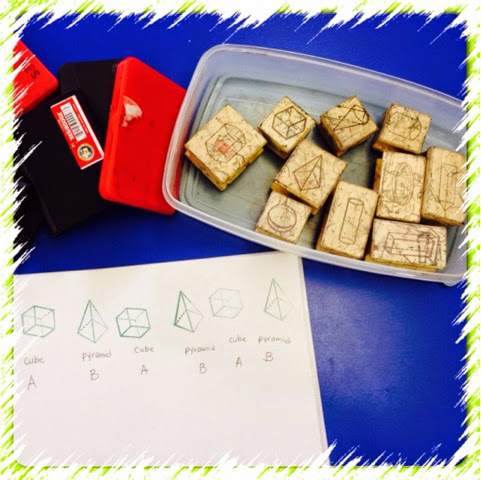
3D objects stamps
paper
ink
label cards for 3D objects (pyramid, sphere, prism etc)

Students at this tub can: create a pattern, identify and label 3D objects, extend a pattern, translate a pattern, discover the names for new objects by examining faces (ie: hexagon faces on a prism = hexagonal prism)

Questions to ask:  What is your pattern?  Can you translate your pattern?  What is the name of that objects?  Can you extend your pattern?  What would come next in your pattern?